We took a trip up the North Shore in September to spend a night in Thunder Bay, Canada. The scenic drive was spectacular as the leaves were turning color and the weather was perfect. One of the stops we made both coming and going was Betty’s Pies at Two Harbors. Betty’s started in 1958 and sells 700 pies a day during the peak summer rush. The food was great as well as the pies.
I have always considered Canada to be just like northern Minnesota. I used to go skiing in Thunder Bay in the 1970’s. The people seem just like us, only friendlier. We stopped at Grand Marais and exchanged our Ben Franklin’s for some Canadian currency. The exchange rate was $133 Canadian for $100 American. But the Canadian money is so colorful. There is a different color for each denomination. And it is a durable plastic coated material with a transparent reflective band in it. The one-dollar coin has a picture of a Loon and is called a “Loonie” The two- dollar coin has a picture of a Polar Bear and is called a “Toonie”.
We had to stop at a Tim Hortons as soon as we arrived. We bought a box of “Timmies”, which are the donut holes. Next was supper at a Pizza parlor where we enjoyed pizza and my wife was able to watch two hockey games at the same time on the tv monitors. We stopped at a grocery store where my wife bought “Shreddies”. I thought they were Wheat Chex, but north of the border they are gourmet breakfast cereal. One is allowed to return to the states with up to $200 in groceries and we put that rule to the test.
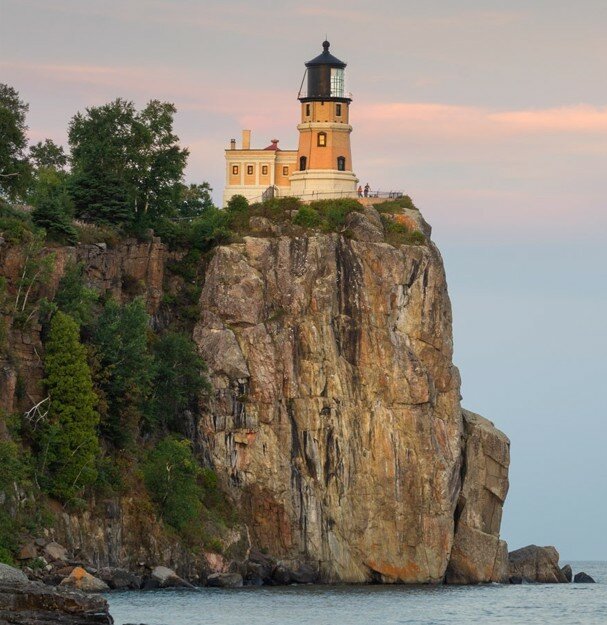
We stopped at Split Rock Lighthouse on the way home to tour the world’s most famous lighthouse. There was a movie presentation about the reasons for building the lighthouse. In 1905 there were 29 ships wrecked on the lake and the State appropriated $75,000 to build a lighthouse, 187’ above the waterline to warn ships away from the rocky shores. The 1,000 watt lightbulb cast a beam that was visible 25 miles across the water. At the time there were no roads in the area and all materials and supplies were shipped in on boats. It was completed in 1910 and the road was built in 1924. Quite impressive to tour the lighthouse and see how the staff kept the beam shining across the waves every night to protect the big ships on Lake Superior.
It was quite sobering to realize the number of ships and sailors who were lost in storms on Lake Superior. Since 1816 over 240 ships have been sunk due to storms on the world’s largest freshwater lake. The last one was on November 10, 1975 and was immortalized by Canadian Gordon Lightfoot’s song “The Wreck of the Edmond Fitzgerald.” The winds reached 60 mph with waves up to 35’ high that fateful night.
The Edmond Fitzgerald was the largest ore boat on Superior when it was built in 1958. 729’ long and carried 27,402 tons of iron ore mined in Minnesota and loaded at Silver Bay. The ore boat made 748 round trips to Detroit Michigan traveling over a million miles. A round trip took 5 days. The ship’s hold could be loaded with taconite pellets in 4 ½ hours. Unloading took fourteen hours. It could reach 16 mph even when fully loaded. The Edmund Fitzgerald had luxury staterooms which accommodated first class passengers who were guests of the shipping company. There was no one but the 29 man crew on board on the final trip.
It was a 74 degree day and before leaving we took the hike down to the lake to admire the sight from the water’s edge. My wife couldn’t resist taking a swim in Gitche Gumee, an Ojibwe word for “big sea”. Had to prove the world’s most dangerous lake was no match for her.